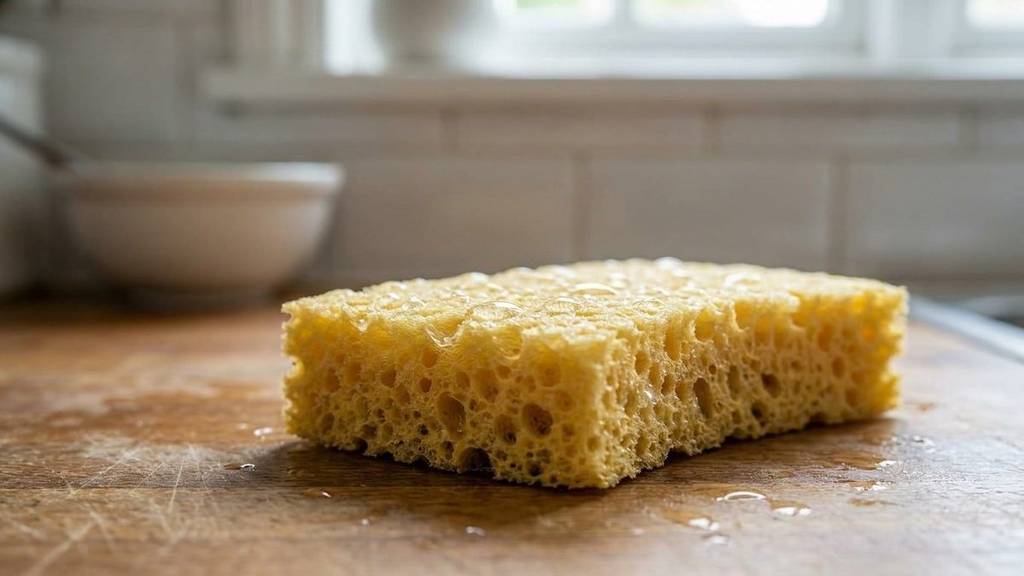
Fifty billion. That is the approximate number of bacteria harbored in a single cubic centimeter of your standard kitchen sponge. To put that in perspective, your sponge is dirtier than your toilet bowl, your kitchen countertops, and even the refrigerator handle. Yet, millions of households perform the same comforting nightly ritual: microwaving the sponge for two minutes. It feels like a deep clean. The microbiological reality? Often the exact opposite of what you intend.
The Hidden Cost of “Clean”
A study published in Scientific Reports by German microbiologists examined the microbial load of kitchen sponges. The findings are grim. These porous sponges are not just dirty; they are incubators. With a standard sponge holding roughly 300 cubic centimeters, the total bacterial load is staggering.
Sponges retain water and take an eternity to dry. Under a microscope, their structure is highly porous. This creates a perfect ecosystem: constant humidity, abundant food residues like raw meat juices or egg shards, and ambient temperatures. It is a five-star hotel for microbes.
“Every square centimeter of a kitchen sponge can host up to 54 billion germs from 362 different species.”
Among these 362 species, many are harmless. But others are serious pathogens. Escherichia, Citrobacter, and Leclercia are frequently found. These can cause intestinal infections, particularly dangerous for those with weakened immune systems. Other common invaders include Salmonella, E. coli, and Staphylococcus.
The Microwave Myth
You might think boiling water or microwave radiation will sterilize the sponge. Science suggests otherwise. These methods eliminate only about 60% of the bacteria. They do not sterilize the object.
Here is the critical failure point: the bacteria that die first are the harmless ones. The dangerous, pathogenic strains are more heat-resistant. By killing off the competition, you inadvertently give the survivors a boulevard to thrive. With more space and resources, the concentration of dangerous bacteria increases rapidly.
Paradoxically, sponges that are regularly “cleaned” may contain a higher percentage of potential pathogens than those that are ignored. This seems counterintuitive. It is Darwinian selection in action. You are selecting for the toughest strains. Even after aggressive treatment, at least 20 billion bacteria per cubic centimeter often remain.
The Only Solution That Works
If heat doesn’t work, what does? The answer is simple, if unsatisfying: change the sponge.
Microbiologists recommend replacing your kitchen sponge at least once a week. In professional commercial kitchens, this is not a suggestion; it is the HACCP (Hazard Analysis Critical Control Point) standard. Sponges are either prohibited or discarded daily. This is not paranoia. It is hygiene.
Even with perfect drying habits, the sanitary lifespan of a sponge is extremely short. It should never exceed a week and a half. After seven to ten days, the bacterial biofilm becomes too robust to be eliminated by simple rinsing or microwaving.
Practical Hygiene Habits
While you wait for replacement day, follow these steps to minimize risk:
- Dry it out: Leave the sponge to air dry away from standing water. Moisture fuels growth.
- Rinse and wring: Rinse thoroughly after every use. Wring it out completely.
- Aerate: Store the sponge in a holder that allows air circulation.
- Specialize: Use different sponges for different tasks. Never use the same sponge to clean the sink as you do to wash glasses or wipe counters.
Consider switching to a brush for dishes. It dries faster and harbors fewer microbes. The sponge, for all its convenience, remains a biological hazard if treated as a permanent fixture rather than a consumable tool.
The question remains: when did we start believing that heating something makes it safe? We cling to the ritual because it feels like control. But biology doesn’t care about our feelings. It only cares about survival. And in your sponge, the survivors are getting stronger.
Ditch the sponge. Your kitchen needs a hygiene upgrade.
It sounds radical. But removing the sponge from your routine is arguably the smartest health move you can make this season.
Standard kitchen sponges are bacterial breeding grounds. They hold water. They stay damp. That warm, wet environment is basically an invitation for Salmonella and other pathogens to set up shop. You scrub the sink with a tool that’s already teeming with microbes. It’s a cycle that doesn’t end well.
The silicone alternative
Enter the silicone scrubber.
From a microbiological standpoint, it’s superior. It doesn’t hold water. Bacteria struggle to adhere to its non-porous surface. You rinse it off. It dries instantly. No lingering moisture means no thriving colonies.
If you prefer tactile options, microfiber cloths or Japanese-style Tawashi brushes work just as well. They’re machine washable. You can toss them in the laundry after a few uses. They air-dry rapidly. They maintain their scrubbing power for months.
The cost of ignoring hygiene
Here is the hard truth.
The most economical choice is also the riskiest. We postpone the replacement. Week after week. We use that same spongy block until it falls apart or smells.
Think about the math.
A basic sponge costs around €0.40. If you replace it every Monday, that’s less than €20 a year. Cheap. Negligible.
Compare that to a visit to the GP.
Summer gastroenteritis hits hard. You don’t always know where it came from. Was it the food? The water? Or the sponge you used to wipe down the counter? A doctor’s consultation for acute illness will easily exceed that €20. The risk-reward ratio is skewed heavily toward replacing the sponge.
Why your current setup fails
You might think your sponge is clean because it looks clean. It isn’t.
The porous structure traps food particles deep inside. Bleach helps, but it doesn’t sterilize the core. Heat helps, but microwave disinfection is inconsistent and can melt certain materials. The sponge remains compromised.
Silicone eliminates the porosity. Fabric allows for high-temperature washing. Both options break the cycle of cross-contamination.
Stop trusting the sponge. Start trusting the swap. The savings are clear. The health benefits are immediate. The only variable left is whether you’ll actually do it before summer hits.