You love your morning brew. You probably love the vessel holding it less. Most office workers treat their mugs as disposable placeholders. You rinse it out. You refill it. You move on.
It feels clean. Hot water kills most things, right? You’re the only one using it.
You’re wrong.
A mostly empty mug left on a desk is a petri dish in disguise. Cold, flu, and oral bacteria don’t just vanish. They thrive in the warm, damp dark.
“The warmer and damper the environment, the more pleasing for bacteria to fester.”
Melissa Maker of Clean My Space puts it bluntly. Your cup collects germs from your mouth. From your hands. From the air.
The Fecal Factor in Your Breakroom
This isn’t just about bad breath. It’s about biology.
Dr. Terry D. Connell, a microbiology professor at the University at Buffalo, notes that Streptococci and Staphylococci hide in unwashed cups. If a coworker takes a sip, their bacteria become yours.
But the office environment is uniquely dirty.
Dr. Charles Gerba at the University of Arizona found something shocking in 1997. Forty-one percent of office coffee cups tested positive for coliform bacteria. That is fecal bacteria.
Most of the time, you won’t get sick from it. But if your immune system is down? You’re in trouble.
The good news is simple. A small office cup washer can wipe out these pathogens. The bad news? Most people don’t use one. They think a quick splash is enough.
It isn’t.
Why Rinsing Fails
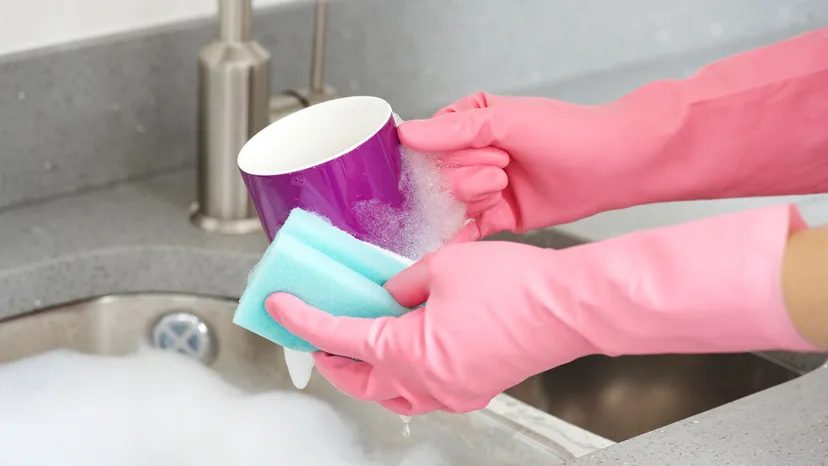
Bacteria adhere to surfaces. They stick. Water alone slides off. Soap is the only thing that breaks that bond.
Public health officials in England issued a plea in January. They wanted reusable cup users to wash thoroughly after every drink. Disposable cup taxes had spiked reusable cup use. The germs didn’t care about the tax.
“Bacteria can adhere to the surface of the cup… Washing with soap is essential to remove those bacteria.”
This is especially true if you add cream or sugar. Sugar feeds bacteria. Milk and cream add proteins and oils. Water can wash away the sugar. It cannot remove the oils. You need soap to strip them away.
The Protocol
You don’t need a dishwasher. You need discipline.
Follow these steps to stop the spread of illness.
- Wash with soap and water after every use. Do not skip this.
- Use a paper towel, not a sponge. Sponges harbor E. coli and Salmonella. Dr. Gerba warns against them. A paper towel is single-use. It stays clean.
- Dry the cup with a paper towel. Moisture encourages growth.
- Wash the lid. The rim collects residue. Don’t ignore it.
The Bigger Picture
Your mug isn’t the only dirty spot.
A Kimberly-Clark study of 5,000+ office surfaces found that 48 percent of coffee pots and dispensers needed disinfecting. You’re washing the cup. What about the machine that fills it?
It’s probably just as dirty.
Start with the mug. It’s the entry point. Ignore the rest, and the cycle continues.
You want that coffee to taste like coffee. Not like last week’s spill.