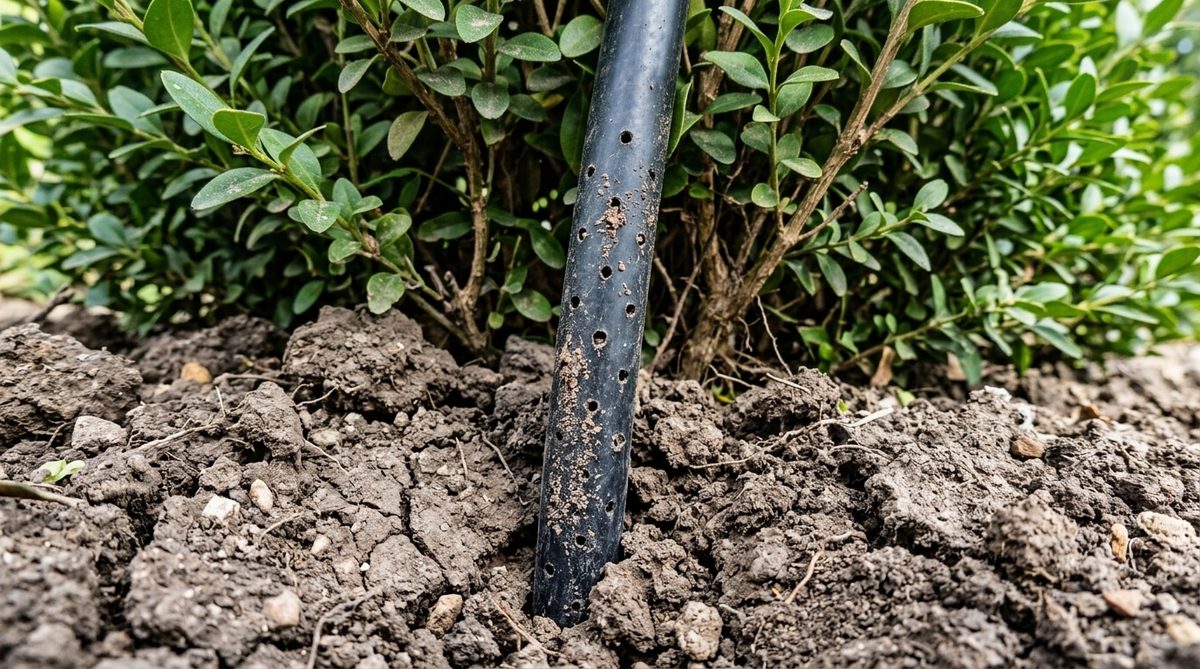
You’ve probably seen them. Little black or white tubes sticking out of the ground near hedges and bushes. It looks weird. It looks like a gardening mistake.
But it isn’t.
During this summer’s brutal heatwaves, neighbors are deploying a simple, ancient technique to keep their plants alive without wasting a drop of water. The object? A perforated PVC pipe. The goal? Survival.
Burying perforated PVC pipes to protect hedges from heat
This isn’t about decoration. It’s about hydrology.
The method is straightforward. You take a thin PVC pipe. You drill small holes along the lower section. Then, you bury it. The depth matters. Aim for 20 to 30 centimeters underground.
Why that depth? Because it bypasses the dry, baked crust on the surface. When you pour water into the open end of the tube, it travels straight to the root zone. The soil on top stays dry. This suppresses weed growth, which saves you time weeding. But more importantly, it keeps the roots cool and hydrated when the topsoil turns to dust.
Targeted deep watering to save roots and water
Surface watering is inefficient. In high heat, most of that water evaporates before it ever touches a root hair.
By delivering water directly to the roots, you cut evaporation losses significantly. Some gardeners report using half the water compared to traditional surface sprinkling. That’s a win for your utility bill and the local reservoir.
There is a biological bonus too. When water sits at the surface, roots stay shallow. They float near the top, vulnerable to drying out. When you force water deeper, the roots have to work harder. They plunge downward to find the moisture. Deep roots mean a sturdier hedge. A hedge that can withstand drought and wind. It becomes autonomous.
Using this system to survive the next heatwave
You don’t need a plumbing degree. You don’t need to spend a fortune.
Grab a piece of PVC pipe from any major hardware store. Leroy Merlin, Jardiland, or your local home improvement center will have them. They are cheap. Reclaimed pipes work too, as long as they are clean.
Here is the setup:
- Cut a section of pipe long enough to reach deep underground.
- Use a drill to punch multiple small holes along the bottom half.
- Bury the pipe, leaving the top open.
- Cover the opening with a small stone or a mesh cap. This keeps bugs out. It also keeps dirt from washing in.
- Pour water into the tube when needed.
The result? Dense, green foliage. No more lugging heavy hoses across the lawn at noon. No more panic when the thermometer spikes.
It’s a small physical adjustment. A few minutes of labor in spring. But the payoff is continuous. You are linking ecological responsibility with practical survival. The sun will still beat down. The soil will still crack. But your plants will be drinking in the dark, deep down, safe and cool.
Is it the only way to survive summer? No. Is it the most efficient way to manage water while keeping your garden lush? For many, yes.
The heat is coming back. The pipe is already in the ground.